Formation
The formation of character is the proper business of a serious life. It is the labour of decades, not of weeks; of habit, not of resolution; of attention, not of intensity.
I · Of the Order
Concerning origin, principles, and the rule of silence.
The Silent Society is a private fellowship dedicated to the disciplined cultivation of the inner life. It draws on the long contemplative tradition of the West — the Stoic schools, the Platonic and Neoplatonic philosophers, the medieval contemplatives, and the early modern reformers of the soul, among whom the figure of the Rose and the Cross has held a place since the seventeenth century.
The Society does not claim a continuous institutional descent from any earlier order. It claims, more modestly and more accurately, an inheritance — a body of texts, a vocabulary, and a manner of working that have been refined across centuries, and that remain available to those who will undertake the labour of study and practice.
It is, in this sense, ancient: not in pretended descent, but in fidelity to a tradition older than any institution we might construct around it.
Four convictions on which the work of the Society rests.
The formation of character is the proper business of a serious life. It is the labour of decades, not of weeks; of habit, not of resolution; of attention, not of intensity.
The principal insights of the Western contemplative tradition are not psychological techniques. They are ways of being, and they cannot be acquired except by sustained reading, conversation, and practice.
The work of self-cultivation is private. It requires no audience, no certification, and no public expression. The presence or absence of attention from others is, finally, irrelevant to it.
A solitary inquirer may advance some distance. A fellowship of serious inquirers, exchanging counsel over many years, advances further. The Society exists to make such fellowship possible.
On Silence
Beneath the rose, in confidence.
Silence is not a tactic of the Society. It is its principal discipline. The Society does not publicise its activities, its membership, or its proceedings. It does not seek attention, and it offers none to those who seek it for themselves.
This silence is not affectation. It is the condition under which the inner work can be conducted without distortion. What is performed for an audience becomes performance; what is announced is no longer one's own.
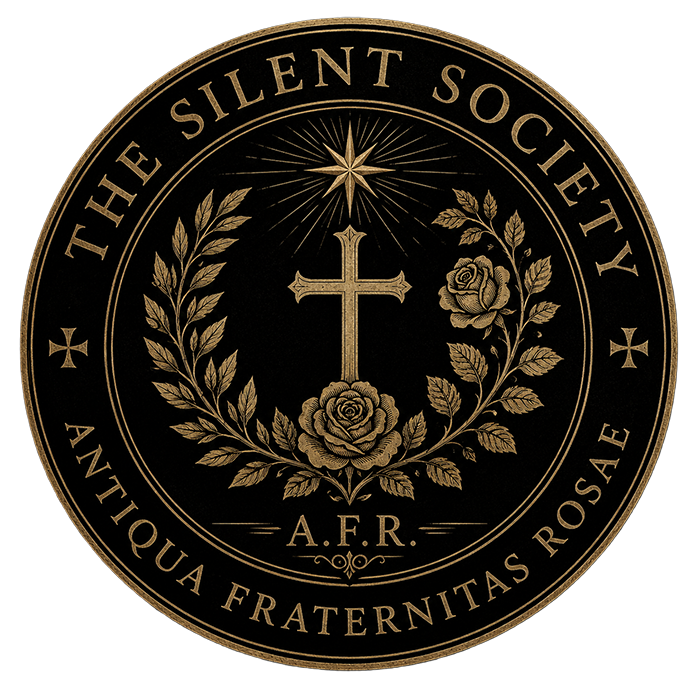
The Society holds, with the older traditions, that the most serious work is done sub rosa — beneath the rose, in confidence. The rose on the seal is a reminder, to each member, of what is owed to that confidence.
Tace et fac. — Be silent, and act.
Those drawn to this manner of working may continue to The Work, or proceed directly to the form of inquiry.
Read The Work